For most real estate brands, digital marketing feels inconsistent.
One month brings a surge of enquiries.
The next month goes silent.
Budgets increase, platforms change—but predictability remains missing.
And in an industry where:
-
Sales cycles are long
-
Deal values are high
-
Trust decides conversions
Unpredictable lead flow is more than a marketing issue.
It’s a business planning risk.
In 2026, the real competitive edge for real estate brands won’t be more portals or higher ad spends. It will be building a predictable digital lead pipeline.
Why Real Estate Lead Generation Breaks Down
Most real estate marketing focuses on visibility.
Projects are promoted through:
-
Portals
-
Social ads
-
Hoardings and listings
While visibility matters, it doesn’t guarantee decision-ready buyers.
The breakdown usually happens because:
-
All leads are treated the same
-
Messaging is generic
-
Sales teams handle too many low-intent enquiries
-
Follow-ups are reactive, not structured
This creates volume—but not consistency.
The Core Shift Real Estate Brands Must Make in 2026
The biggest shift is this:
From “getting more enquiries” → to “engineering buyer journeys.”
Predictable pipelines aren’t built on platforms.
They’re built on systems.
The Predictable Real Estate Growth Framework
1. Start With Buyer Intent, Not Just Location
Most campaigns are built around:
-
Project location
-
Price ranges
-
Amenities
But buyers move forward based on:
-
Life stage
-
Investment intent
-
Risk perception
-
Trust in the developer
Growth-driven real estate brands segment audiences by intent, not just demographics.
2. Separate Browsers From Buyers Early
In real estate, not everyone enquiring is ready.
Predictable brands:
-
Use ads and messaging to qualify upfront
-
Clearly communicate price bands, timelines, and possession
-
Educate before pushing site visits
This reduces enquiry volume—but dramatically improves sales conversations.
3. Build Funnel-Specific Landing Pages
Sending all traffic to one generic project page is a major leak.
High-performing brands create:
-
Lead education pages for early-stage buyers
-
Investment-focused pages for serious investors
-
Channel-partner-specific funnels
Each page answers a specific buyer question—not everything at once.
4. Design Follow-Ups That Match Buyer Readiness
Not every lead should get a call immediately.
Predictable pipelines rely on:
-
Lead nurturing for early-stage interest
-
Timed follow-ups for evaluation-stage buyers
-
Sales calls only when intent signals are strong
This alignment protects sales bandwidth and improves close rates.
5. Measure Pipeline Health, Not Just Leads
Most real estate dashboards stop at:
-
Cost per lead
-
Enquiry volume
Growth-focused brands track:
-
Site visit conversion rates
-
Lead-to-booking ratios
-
Time-to-decision
-
Revenue contribution by channel
This is what allows forecasting—not guessing.
Why Real Estate Brands Struggle to Scale Ads
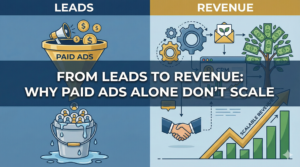
Paid ads work exceptionally well for real estate—but only when the system is ready.
Without:
-
Clear qualification
-
Conversion-focused assets
-
Structured follow-up
Scaling ads simply scales:
-
Noise
-
Low-intent enquiries
-
Sales fatigue
Predictable brands treat ads as accelerators, not foundations.
What the Best-Performing Real Estate Brands Do Differently
They don’t ask:
“Which platform should we advertise on?”
They ask:
“Where is the buyer dropping off—and why?”
Their growth decisions are driven by:
-
Funnel gaps
-
Sales feedback
-
Buyer behaviour data
This is how consistency replaces volatility.
Where GPD’s Role Comes In
At GoProDigitally, real estate growth is approached as a long-term system, not a campaign sprint.
The focus is on:
-
Mapping buyer journeys
-
Aligning ads, landing pages, and sales teams
-
Designing pipelines that remain stable—even when markets fluctuate
Because in real estate, growth isn’t about one successful launch.
It’s about repeatable demand generation.
A Question Every Real Estate Leader Should Ask
Ask yourself:
“If our best-performing salesperson left tomorrow, would our pipeline still be predictable?”
If the answer is no, growth is dependent on people—not systems.
And systems are what scale.