Digital marketing today looks deceptively simple.
Run ads.
Post on social media.
Build a website.
Generate leads.
Yet, despite spending lakhs — sometimes crores — most businesses quietly feel the same frustration:
“We’re doing digital marketing… but it’s not really driving growth.”
This isn’t a budget problem.
It’s not a platform problem.
And most of the time, it’s not even a performance problem.
It’s a strategy problem.
The Illusion of “Doing Digital Marketing”
Many businesses believe they’re investing in digital marketing because they’re visible online.
They have:
-
Active ad campaigns
-
A decent-looking website
-
Social media presence
-
Some leads coming in
But visibility is not growth.
Growth happens when every digital activity moves the business toward a clear revenue objective. Without that alignment, marketing becomes a series of disconnected actions — busy, expensive, and underwhelming.
This is where most businesses fail.
The 5 Core Reasons Digital Marketing Fails for Most Businesses
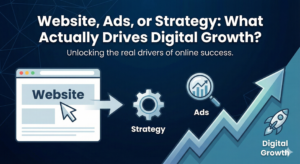
1. They Start With Tools, Not Outcomes
The first question many businesses ask is:
“Which platform should we use?”
Instead of:
“What business problem are we solving?”
Ads, SEO, landing pages, and websites are execution tools, not growth drivers on their own. Without clarity on outcomes — revenue targets, deal size, sales cycles — tools only amplify confusion.
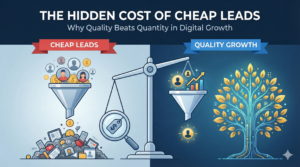
2. They Chase Leads, Not Revenue
A dashboard showing hundreds of leads feels productive.
But leads without intent, quality, or follow-up systems don’t translate into revenue.
Growth-driven brands focus on:
-
Lead quality over volume
-
Cost per qualified opportunity
-
Conversion across the entire funnel
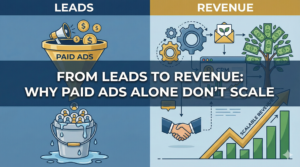
Marketing success isn’t measured at the lead stage — it’s measured at the revenue stage.
3. They Treat Marketing as a Vendor Task
One agency runs ads.
Another builds the website.
A freelancer handles content.
Each executes well in isolation, but no one owns growth as a whole.
When marketing is fragmented, accountability disappears. And when accountability disappears, results become inconsistent.
4. They Ignore the Middle of the Funnel
Most businesses obsess over:
-
Traffic
-
Impressions
-
Clicks
But growth often breaks down in the middle:
-
Poor landing page experience
-
Weak messaging
-
No trust signals
-
Confusing next steps
Growth-driven brands obsess over what happens after the click, not just before it.
5. They Expect Short-Term Fixes for Long-Term Growth
Quick hacks.
Short campaigns.
One-time optimizations.
Sustainable growth doesn’t come from bursts — it comes from systems. Brands that scale think in quarters and years, not weeks.
What Growth-Driven Brands Do Differently
Businesses that consistently grow through digital channels don’t “do more marketing.”
They do better-aligned marketing.
Here’s how their mindset shifts.
1. They Start With a Growth Strategy, Not Campaigns
Before running ads or building pages, they define:
-
Target audience clarity
-
Revenue goals
-
Funnel structure
-
Key growth constraints
Marketing becomes a means, not the goal.
2. They Build Integrated Growth Systems
Ads, landing pages, websites, and follow-ups aren’t separate tasks — they’re connected pieces of one system.
Every component answers one question:
“Does this move the prospect closer to a buying decision?”
3. They Measure What Actually Matters
Instead of surface metrics, they track:
-
Cost per qualified lead
-
Conversion rate across stages
-
Sales velocity
-
Customer acquisition cost vs lifetime value
This clarity allows smarter decisions, not reactive ones.
4. They Partner, Not Outsource
Growth-focused businesses don’t look for vendors to “run things.”
They look for partners who think like business owners, understand numbers, and take responsibility for outcomes — not just execution.
Digital Growth Is Not About Doing More. It’s About Doing What Matters.
Digital marketing doesn’t fail because platforms don’t work.
It fails because:
-
Strategy is unclear
-
Execution is disconnected
-
Growth ownership is missing
When businesses shift from task-based marketing to growth-led thinking, results compound — not spike temporarily.
This is the difference between running marketing and building growth.
Where GPD Fits In (Without the Sales Pitch)
At GoProDigitally, the focus isn’t on isolated services.
It’s on:
-
Understanding where growth is leaking
-
Designing systems that scale
-
Aligning marketing with real business outcomes
Because in the end, businesses don’t need more agencies.
They need clarity, alignment, and a growth partner who thinks long-term.
A Thought to Leave You With
Before your next marketing decision, ask:
“Is this helping us grow — or just helping us stay busy?”
That answer usually changes everything.